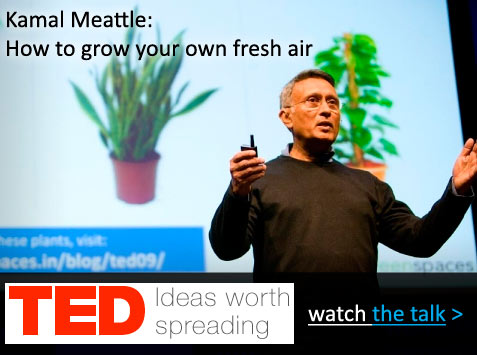
(Recorded at TED U 2009, February 2009, in Long Beach, California. Duration: 04:04.)
TED LINK: Why you should listen to him >>
Get the slide deck from this talk >>
| PBC-STIP: Instant Offices | Conference Rooms | Art Gallery | Tours & Travel | Cooling Towers | GreenSpaces | Facility Management |
|
|
|

(Recorded at TED U 2009, February 2009, in Long Beach, California. Duration: 04:04.)
TED LINK: Why you should listen to him >>
Get the slide deck from this talk >>
Details here.

Want to Live Longer? Cut the Pollution
By Tiffany Sharples, TIME, Jan. 22, 2009
Nobody pretends that polluted air isn’t terrible for your health. Clean up the skies over any dirty city, and the people who live there will all but certainly become healthier. That, at least, has been popular wisdom, but until now, no one had ever put it to a statistical test. Now someone has, and the results are striking: according to a study just published in the New England Journal of Medicine, when local governments decide to scrub out the smog, local residents actually live an average of five months longer.
“It’s very reassuring,” says Dr. Douglas Dockery, one of the study’s three authors and an environmental epidemiologist at Harvard’s School of Public Health. “We can see some benefits from the regulations of air pollution that have been put in place in the past 20 to 30 years.”
In order to reach so precise a finding, the study’s authors had to do some exhaustive number-crunching, surveying pollution rates and longevity in 51 cities across the U.S. over a 21-year period from 1979 to 2000. Overall, they found that lifespan in all of the areas increased by an average of nearly three years — from 74 to 77 — as a result of a host of factors, most notably reduced smoking and improved income. But 15% of the change was attributable to cleaner air.
Read rest of the article here | Read the New England Journal of Medicine Report
Photo credit: springm

From TIME Magazine’s interview with Person of the Year President-elect Barack Obama:
More than ever, I think, a wholesale investment in transforming our economy — from retrofitting buildings so that they’re energy-efficient to changing our transportation patterns and thinking about how to rebuild our electricity grid — those are all things that we’re going to need now more than ever.
And then the final thing, just to round out my Happy List, is climate change. All the indicators are that this is happening faster than even the most pessimistic scientists were anticipating a couple of years ago. It is going to require an enormous effort on the part of the global community to deal with it. And it is not going to come without cost. Trying to bring about that transformation — which I think offers huge opportunities for economic growth and job creation over the long term, but will entail some costs in the short term — you know, that’s the hardest thing to do in politics, right? To make big investments in things that have long-term payoffs.
Read the entire TIME interview here.
Photo credit: BohPhoto
Take to low carbon technologies
The Financial Express, 2008-12-20
New Delhi: Releasing the first ever survey of corporate India’s environment consciousness, RK Pachauri, chair of the Nobel prize winner Inter Governmental Panel on Climate Change, said on Friday, “If we want to succeed economically, we have to move towards low carbon emitting technologies”. The pioneering survey is a joint venture between The Financial Express and Emergent Ventures India (EVI).
Pachauri told a distinguished gathering of industry leaders, academics and students at Energy & Resources Institute (Teri) University here, “the adverse impact of climate change is the greatest challenge of this century and the industry must has to rethink its water usage strategy so that less water intensive industrial techniques are adopted across the country”.
The FE-EVI survey covers the top corporates of India as tracked by the FE 500. Releasing the result of the survey How Green is your Business, Pachauri stated that one of the ways the industry could take the environment agenda forward was to be more discerning of the usage of water.
His comments triggered an exciting panel discussion among the CEOs of some of India’s leading companies across sectors. Taking Pachauri’s view forward, Naina Lal Kidwai, group general manager and country head, HSBC India, said adherence to green financing norms ought to occupy more space in discussions between companies and financial institutions for financing projects.
The discussion created an immediate rapport with the large audience in the winter afternoon whose questions kept the session going way beyond the scheduled time for wrapping it up.
Besides Kidwai, the panel included Subir Raha, former chairman of Oil and Natural Gas Company (ONGC) and chairman, Team Raha Ideation Ltd, Samir
Modi, managing director, Colorbar Cosmetics, Rajdeep Sahrawat, vice-president, Nasscom, Sohinder Gill, chief executive officer, Hero Electric, Harshpati Singhania, managing director, JK Paper, K Ravi Kumar, chairman, Bharat Heavy Electrical Ltd (Bhel), Mark Runacres, senior fellow, Teri and former British deputy high commissioner, Kamal Meattle, CEO, Paharpur Business Centre and Software Technology Software Incubator Park and Vinod Kala from EVI.
The debate was centered around whether there was a need for creation of more regulations for industry or to make it a bottom up approach where pressure from investor community on the industries will drive green technology.